
Azilal
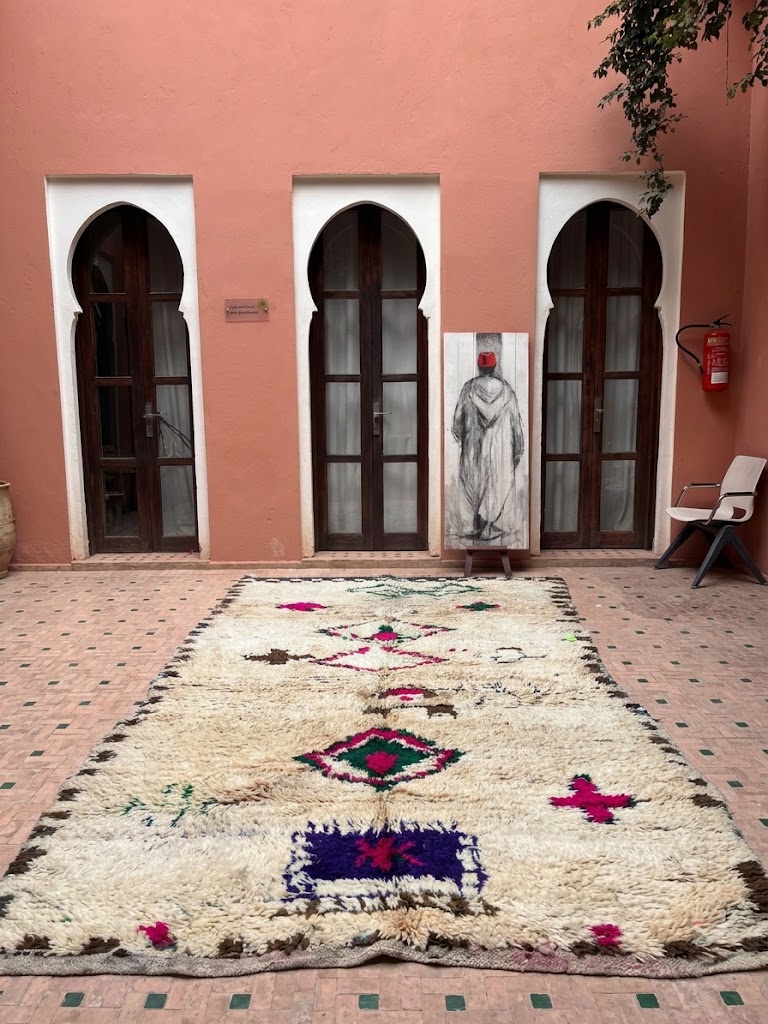
It comes from the central Atlas, from the province that gives it its name, where the High Atlas meets the Middle Atlas. High valleys such as Aït Bouguemez, villages of stone and earth, long winters. An Azilal rug is easy to recognise: a ground of undyed wool, almost white, and over it a drawing in colour that looks traced freehand.
The structure is that of the pile rugs of the Atlas: wool, a light ground, diamonds and broken lines. It is the same grammar as a Beni Ouarain, spoken in another voice. Where the Beni Ouarain keeps to black on ivory, the Azilal adds reds, oranges, pinks, blues and yellows, spread with a freedom closer to a Boucherouite.
The pile is lower and the rug lighter. That leaves room for detail: fine strokes, small symbols, outlines that read up close. Many older pieces are medium or small in size, woven for everyday use in the home and easy to move. It is a Berber mountain rug made for the cold, without the bulk of a high-pile rug.
Each one was woven by a woman, often the eldest in the family, on an upright loom over weeks or months. Into it she wove a repertoire of signs learned from her mother: figures the amazigh tradition links to fertility, birth, protection or union. They were not copied from a model. Each weaver combined them in her own way, which is why an Azilal allows asymmetry, loose figures and motifs that change their mind halfway through.
Traditionally, the dyes came from the land around: madder for reds, indigo for blues, henna and valley plants for yellows and ochres. Many vintage pieces already combine naturally dyed wool with synthetic dyes, which explains some of the brighter tones. It is part of the rug’s history and takes nothing away from it.
At home it works as a note of colour over a quiet base: at the foot of a bed, in a living room with pale floors, or hung on a wall like a tapestry. The low pile also makes it comfortable under a table. Caring for it is simple: vacuum without a rotating brush, lift stains dry or with cold water, without rubbing, and keep it out of direct sun, which fades colour over the years.
It is a Berber rug you look at the way you look at a drawing. The Azilal pieces in the collection are photographed in natural light with no colour retouching, and you can see them at the showroom in Vitoria-Gasteiz by appointment.
Other pieces in the same amazigh tradition: Beni Ouarain and Boucherouite. Back to all styles

