
Beni Ouarain
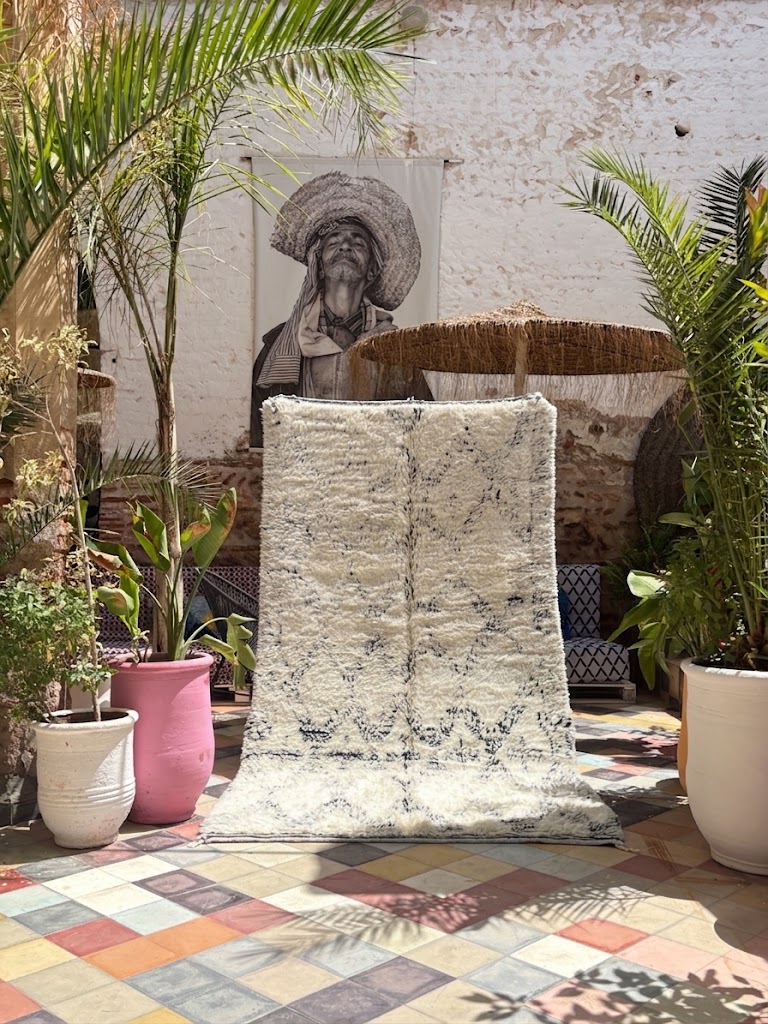
The most internationally recognised amazigh rug. An ivory wool ground, a few black lines drawing a grid or a diamond, a deep pile. A minimal language — neutral base, firm geometry, nothing superfluous — now familiar in contemporary interiors across Europe and North America.
The Beni Ouarain are a confederation of seventeen amazigh tribes in the northern Middle Atlas. It is woven at altitude, where winter is long and textile answers a need rather than an ornament. Hence the thick pile: it insulates from the floor and serves at once as bedding and blanket. The wool is the local sheep’s, undyed, in ivory and dark brown.
The restraint of the design has a reason. Mountain life, apart from the craft centres of Fès and Marrakesh, kept taste clear of urban ornament. The fine lines and diamonds do not descend from the arabesque. They belong to a separate visual culture, closer to abstraction than to decoration.
The weaving begins at a vertical loom. A firm warp, a knot tied by hand, set high and dense to raise the pile. The piece advances slowly. Shifts of tone in the wool, or a line that does not close the same, are part of the weave.
In a room it works through stillness. Over a neutral floor, among sober lines, it orders without competing. The ivory quiets, the geometry holds the eye, the high pile settles the step.
Care is simple. A gentle vacuum, in the direction of the pile, no rotating brush. Turning the piece twice a year spreads the wear.
Other pieces in the same amazigh tradition: Boucherouite and Boujad. Back to all styles


