Boucherouite
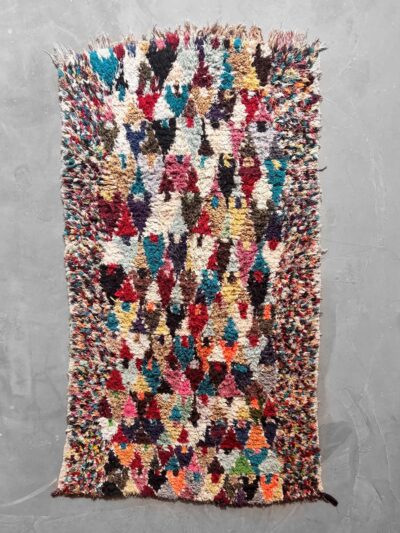
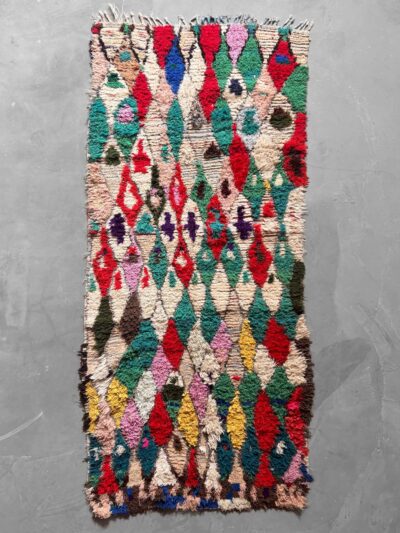
Boucherouite does not name a region or a tribe. It names a way of weaving: knotting scraps of cloth onto the loom instead of carded wool. It appears where wool is scarce or kept for the important pieces, and weaving carries on with whatever is at hand —cotton, worn clothing, loose fibre, sometimes metallic thread—. This is why a Boucherouite can come from different tribes: what links them is the reclaimed material, not a shared origin.
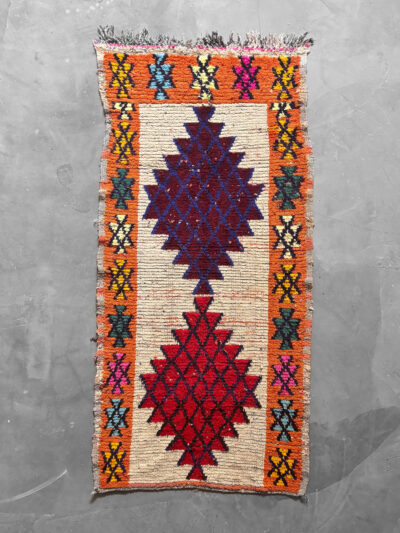
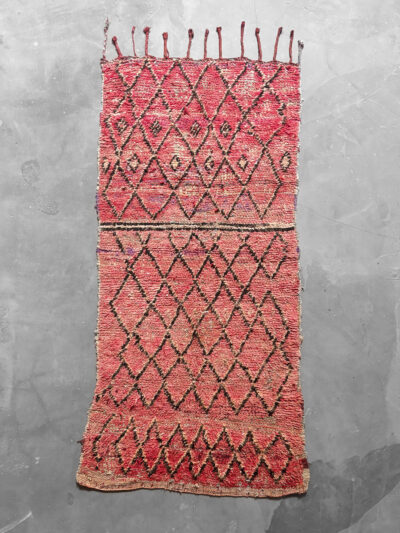
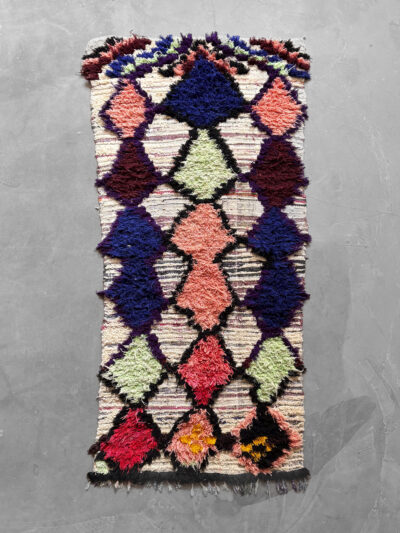
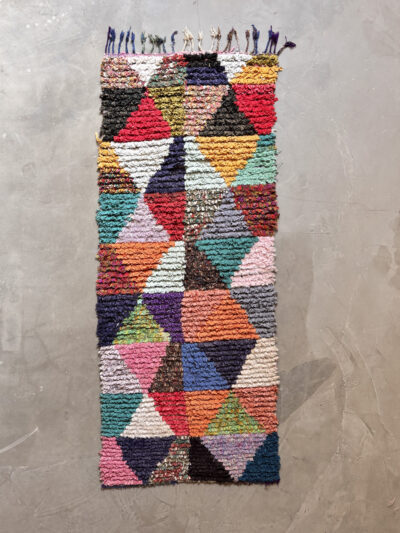
Within the Amazigh tradition these are the pieces closest to twentieth-century abstraction. No two are alike, because none starts from the same pile of scraps.
None of these rugs was woven to be looked at. They were made for the floor of a house, to keep out the cold, to sleep on. The reading that now places them close to twentieth-century painting came later, and was foreign to the women who wove them. Much of their interest lies there: poor material and rich composition, with no intention of style. The design does not seek to close within the border, and many pieces give the impression of continuing beyond the weave.
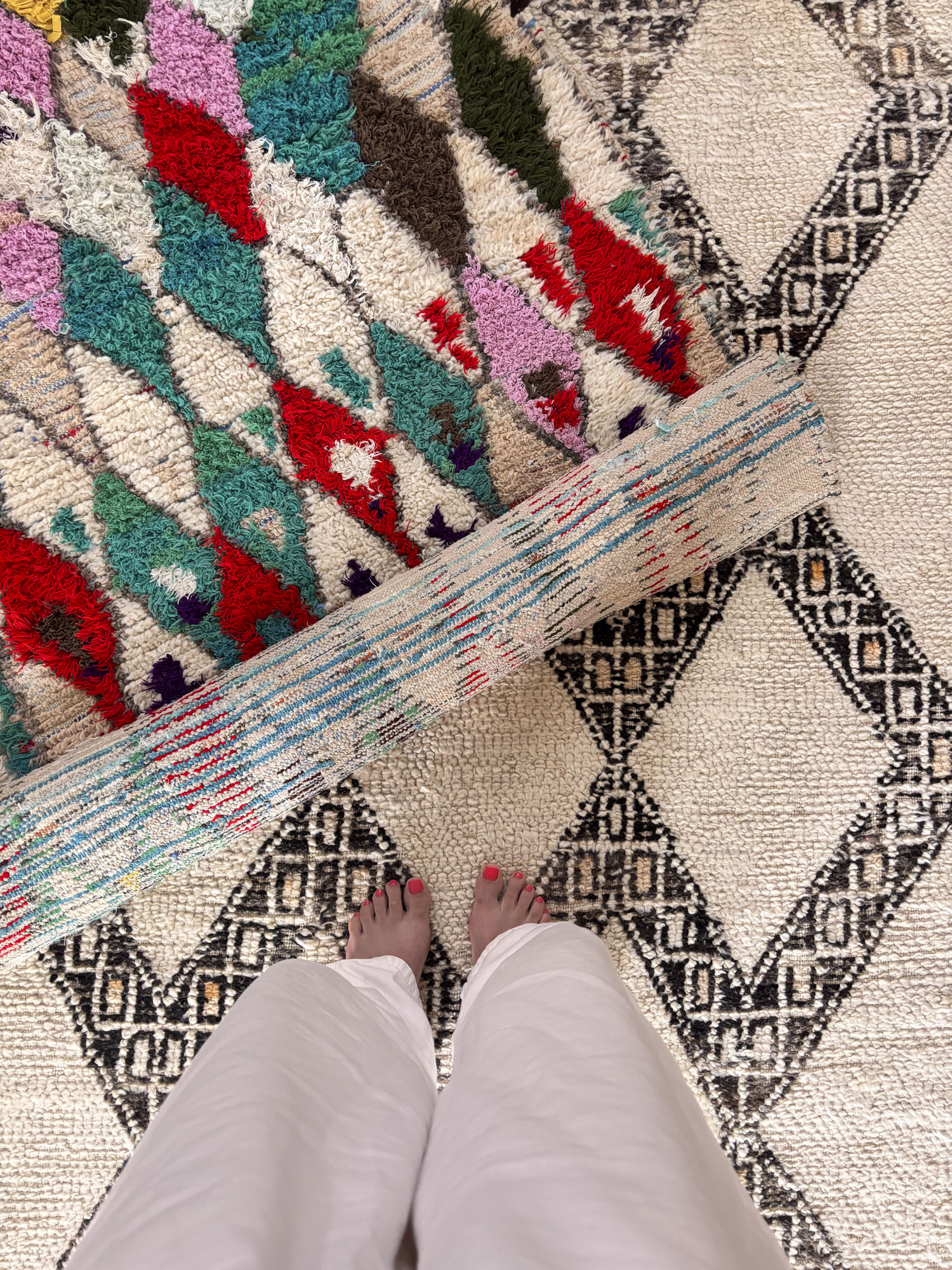
The technique starts from a vertical wooden loom, a firm warp and a hand-tied knot. The strips are cut and knotted just as the fleece would be knotted in a wool Berber rug. The pile is irregular, with different heights and thicknesses depending on the fibre of each strip. The back shows the work: the tighter the knot and the more regular the weave, the more hours lie behind it. The proportion of fibres changes the feel. Cotton and wool give a matte surface; synthetic fibre shines under direct light. Reusing the material was a condition, not a programme.
In an interior it works by contrast. Over a neutral floor, among furniture of sober lines, it orders the room through colour. Medium and small formats sit at the foot of a bed, under a low table, in an entrance hall, or layered over a larger flat-weave rug. The pile, short or medium, withstands foot traffic better than the high wool of a Beni Ouarain. Against prints or strongly coloured furniture, it cancels itself out.
Care is simple: gentle vacuuming, in the direction of the pile and without a rotating brush. Deal with stains promptly, using lukewarm water and neutral soap, without rubbing. Turning it now and then spreads the wear. Direct, continuous sunlight dulls the tones. Since it mixes different fibres, it should not go in the washing machine or be soaked: a thorough clean is a job for a professional rug service.
The name says almost everything: boucherouite is a scrap, a strip of reused cloth. It designates a way of weaving, not a geographical area, which is why a Boucherouite can come from different tribes. It is made mostly of cotton, with wool and other reclaimed textile fibres; the mix varies from piece to piece and is noted on each listing, and it is what explains its colour and its lightness compared with a pure-wool rug. What sets it apart from other Berber rugs is that it follows no regional repertoire: where a Boujad or a Marmoucha answers to the motifs of its own tribe, the Boucherouite improvises. It is the most graphic and the least predictable of the family.