
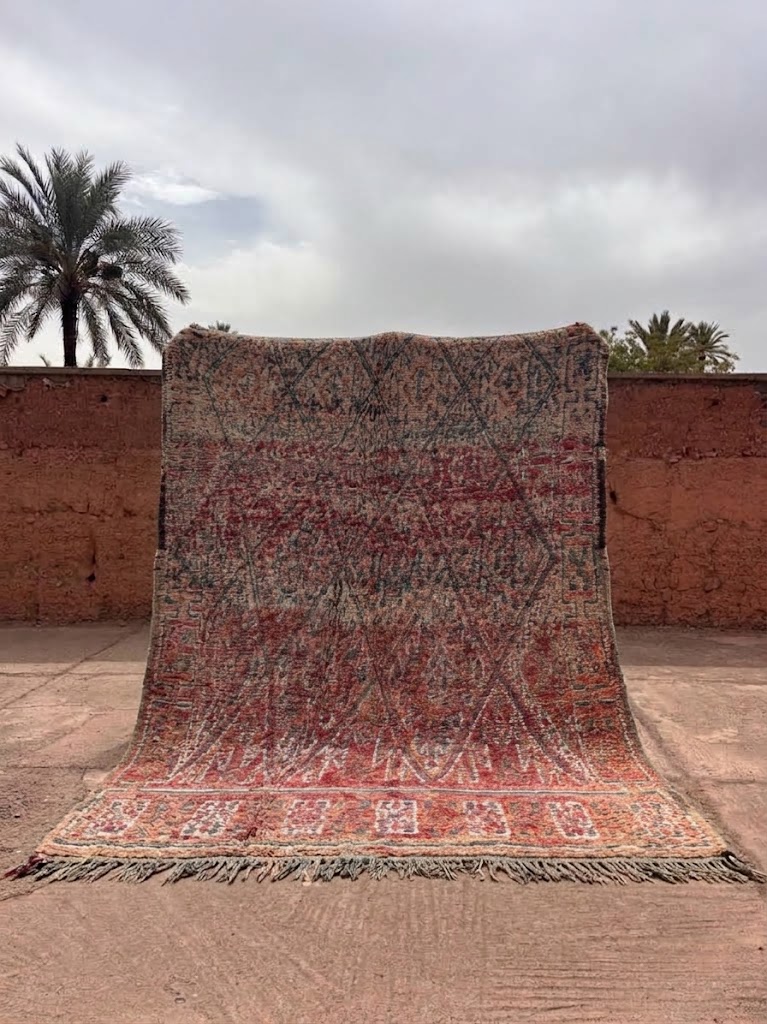
Beni M'Guild
Beni M’Guild rugs are woven in the Middle Atlas, on the western slope of the range, between Khenifra and Midelt. Beni M’Guild is not a tribe but an Amazigh confederation, one of the largest in the area; it was once part of a wider group, the Aït Oumalou, “the people of the shade”, named for the slopes where they lived. That shade is not hard to see in the rugs, in the way the colour shifts tone on tone.
Colour is its signature. Where a Beni Ouarain works the wool undyed and stays in ivory, the Beni M’Guild dyes: grounds of earth, ochre, red and garnet, and over them deep purples, aubergines and indigos, sometimes cut by a live orange or blue. Traditionally, the dyes came from plants: madder for the reds, indigo for the blues. Over the years those tones settle and melt into waves, and much of the rug’s depth lies there.
It is a Berber mountain rug. The Middle Atlas is cold and harsh for much of the year, and these pieces were woven thick out of necessity: wool on wool, high dense pile, tight knot. They were not made as something to look at, but to warm the floor of a house and serve as a blanket. The wool comes from local sheep, rich in grease, and that is where their feel and their weight come from.
The design mixes the geometric with the free. Chained diamonds and lozenges, broken lines, herringbone, ordered in bands but never in exact symmetry: each motif falls where the weaver chose to place it. No two are alike, because the design is decided on the loom, without a template.
It is woven by hand on a vertical wooden loom, knot by knot, line by line. It is long work, often months, and often shared: several women weaving the same piece over conversation and tea. The back tells the hours: the tighter the knot and the more regular the weave, the more work lies behind it.
In an interior, a Beni M’Guild orders the room through colour. Over a neutral floor and furniture of sober lines, it sets the tone for everything else and brings warmth to a dark room. Like most high-pile Berber rugs, it asks for space and works as a centre, not as an accompaniment. If colour draws you but with a looser, almost painted geometry, a Boujad goes that way.
Care is simple: gentle vacuuming, in the direction of the pile and without a rotating brush, which pulls at the knot. Deal with stains dry and without rubbing; if water is needed, cold, with a clean cloth. Turn it now and then to spread the footfall and the light. High wool may shed a little in the first months; this is normal and passes.
